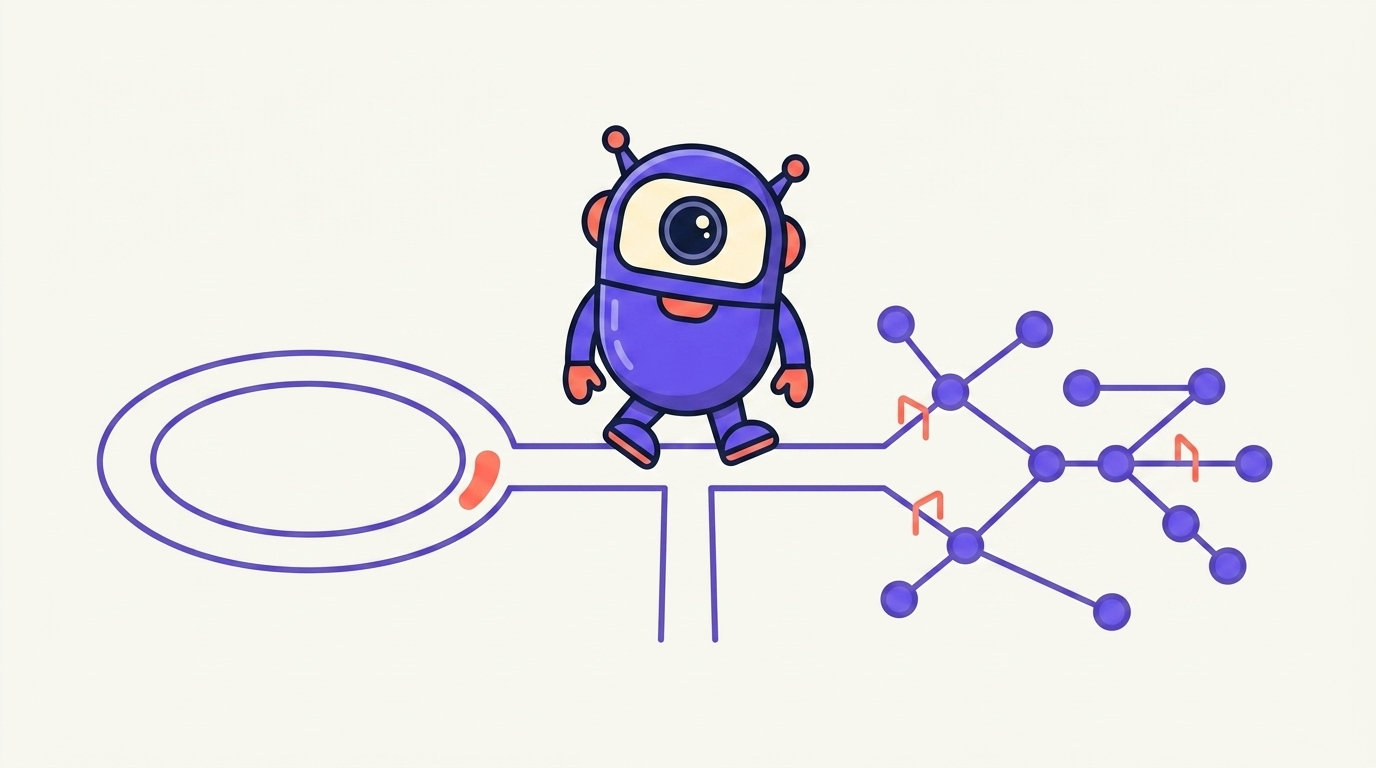
If you build with AI coding agents, the useful question is not loops or graphs. It is which decisions belong to the model and which must stay explicit. The loop supplies autonomy. The graph supplies control over state and transitions. Reliable systems combine both: a bounded loop inside a workflow that knows when to retry, branch, stop, or ask a person.
What the agentic loop actually is
Strip away the branding and most tool-using agents follow the same cycle. The model reads the goal and current state, reasons about the next action, calls a tool, observes the result, updates the working state, and checks whether to continue. This is the family of patterns formalized by ReAct. The loop is what lets a model chain twenty steps together instead of answering once and stopping.
Feedback makes the loop self-correcting within a run. A failed test, tool error, changed file, or human response becomes the next observation, so the agent can revise its plan. That does not usually retrain the underlying model or guarantee improvement across future sessions. It changes the state available to the next decision. Good feedback is specific, timely, and tied to a verifiable result.
This explanation is grounded in the original ReAct paper, Anthropic’s current description of trustworthy agents, and the official LangGraph Graph API model of state, nodes, and edges.
Why the loop wanders
An unbounded loop has one structural flaw, and it is the same trait that makes it powerful: the agent controls too many of its own exits. If the finish check is vague, a prompt like fix this bug can become a fifteen-file reading tour before the agent writes a line. A large task becomes a thirty-tool-call detour that bloats context, increases latency and cost, and makes later decisions depend on noisy state.
The failure modes are predictable: drift from the user’s goal, silent failure behind plausible output, repeated actions, runaway token spend, and unsafe tool use. Security matters because every new tool expands what the loop can touch. The fix is not to remove autonomy. It is to bound it with iteration limits, permission checks, test oracles, budget ceilings, and explicit conditions for asking a human.
What graph thinking buys you
A graph is the loop with its control made visible. Instead of one blob that runs until it feels done, the workflow has state, nodes, and edges. Nodes perform work. Edges decide what runs next. Conditional edges can retry a failed step, route to a different specialist, stop at a budget limit, or pause until a person approves. LangGraph uses this exact model, and its graphs can still contain loops.
The payoff is not prettier diagrams. It is determinism where you need it and model judgment where the path is genuinely unpredictable. Use a plain loop for open-ended research, debugging, or tool selection. Use a graph when the work has required stages, expensive branches, security boundaries, multiple agents, or a human approval that must not be skipped. Most production systems need a graph that contains one or more bounded agentic loops.
You do not need a rewrite to think in graphs
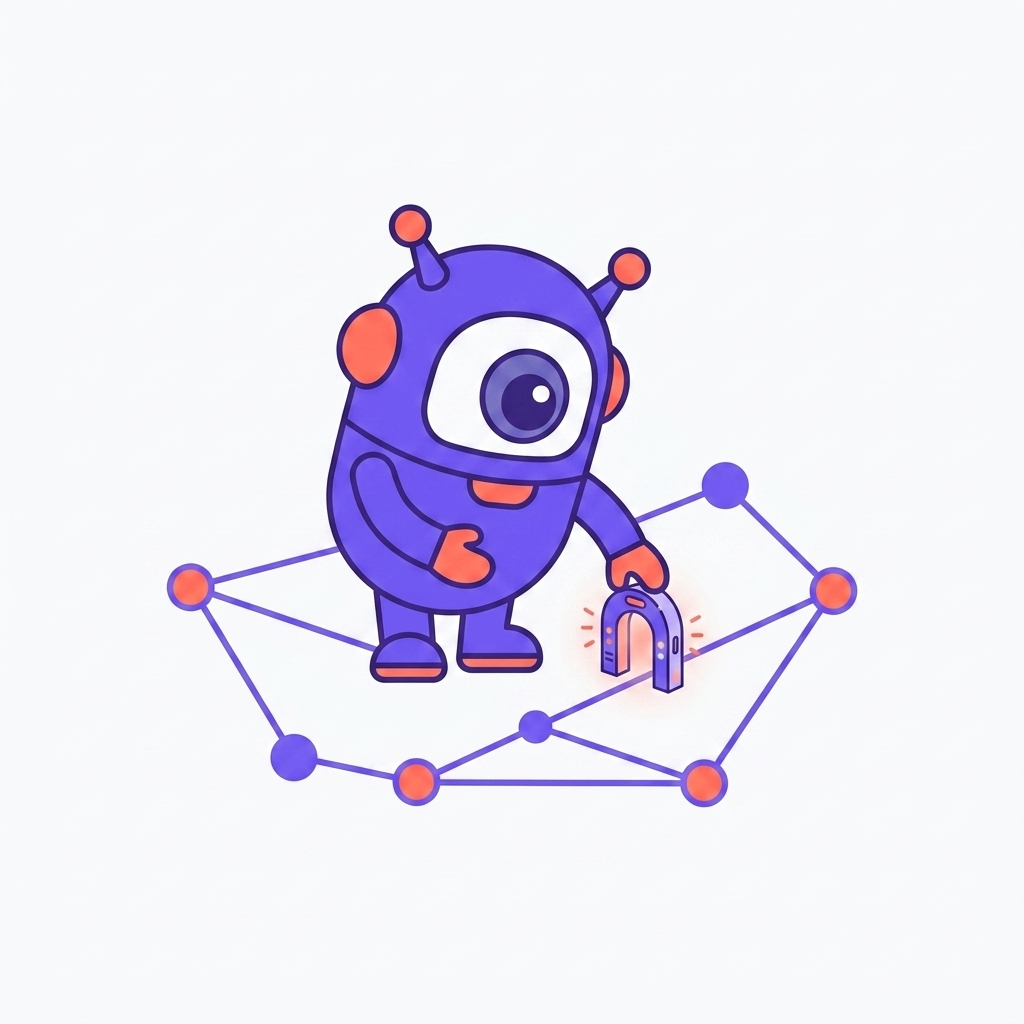
Here is the part the framework debates miss. Thinking in graphs does not require you to throw out your agent and adopt a graph runtime. Most people reading this are not building an orchestration platform. They are running a coding agent like Claude Code or Codex and they want it to stop wandering. You do not need LangGraph for that. You need edges: a few control points bolted onto the loop you already have. The graph is a way of thinking first, and a framework only if you actually need one.
Your hooks are graph edges
This is the part most people have not noticed. A hook is code that runs at a fixed point in the agent's lifecycle and can change what happens next. That is an edge with a gate on it. So kitstarter's entire design is graph engineering applied to a coding agent, with zero graph framework. Three hooks, three gates:
UserPromptSubmit and can deny. It holds the agent at the first edge until you confirm what you actually want, so it plans before it builds instead of guessing.PreToolUse and returns allow, deny, or ask before a risky action. It is a gate on the edge into every tool call, the checkpoint the bare loop never had.Task boundary into every subagent, so spawning five agents does not spawn five unbounded loops.The loop gave agents autonomy. The graph gives them accountability. You want both.
The whole argument, in one line.
So, loops or graphs?
Both. The loop is the engine that lets the agent do multi-step work. The graph is the steering that controls state, transitions, checkpoints, and exits. A loop without external constraints is difficult to trust. A graph with no agentic loop is just a fixed workflow. The practical architecture is a graph around bounded loops, even when the product calls those edges hooks, permissions, evaluators, or approval gates.
If you want that shift without building an orchestration layer, that is what kitstarter is: an ask-first clarity gate, a safety guard on every tool call, and rules that survive into subagents, installed as native lifecycle hooks for Claude Code and Codex. You keep the loop. You get the graph. And the agent stops being something you supervise and starts being something you can hand real work.
Common questions
What is an agentic loop? An agentic loop is the execution cycle that lets an AI agent read a goal and current state, reason about the next step, act through a tool, observe the result, update its state, and repeat until a stop condition is met or a person needs to intervene.
What is the difference between an agent loop and an agent graph? A loop is one process that runs until the agent judges it finished, with no outside control points. A graph breaks the same work into explicit nodes and edges, where some edges are gates the agent cannot cross without a check passing or a person approving. The loop gives autonomy, the graph adds control, and the most reliable agents combine them: a loop for the work, a graph for the guardrails.
What is graph engineering? Graph engineering is the practice of designing an agent system as explicit state, nodes, and transitions. Nodes perform work, while fixed or conditional edges control what runs next. The graph can include loops, retries, branches, budget limits, and human checkpoints.
Do I need LangGraph to use graphs? No. LangGraph helps if you are building a complex orchestration system, but the core idea, adding control points to an otherwise free-running loop, does not require it. For a coding agent like Claude Code or Codex, native hooks give you the same thing: gates on the agent's lifecycle that confirm scope, block risky actions, and hand control back to you.
What role do feedback loops play in agentic AI systems? Feedback gives the next decision evidence about the previous action. Tool results, tests, errors, environment changes, and human responses update the agent's working state so it can correct course. This enables adaptation within a run, but it does not necessarily retrain the model or create permanent learning.
What stops an agentic loop? A loop should stop when a verifiable success condition passes, an iteration or cost limit is reached, a safety rule blocks the next action, the agent cannot make progress, or the workflow requires human approval. A vague model judgment should not be the only exit.
Give your agent edges, not just a loop
kitstarter installs the gates that turn a free-running loop into a control graph: ask-first clarity, a safety guard on every tool call, and rules that survive into subagents. For Claude Code, Codex, and Antigravity.